
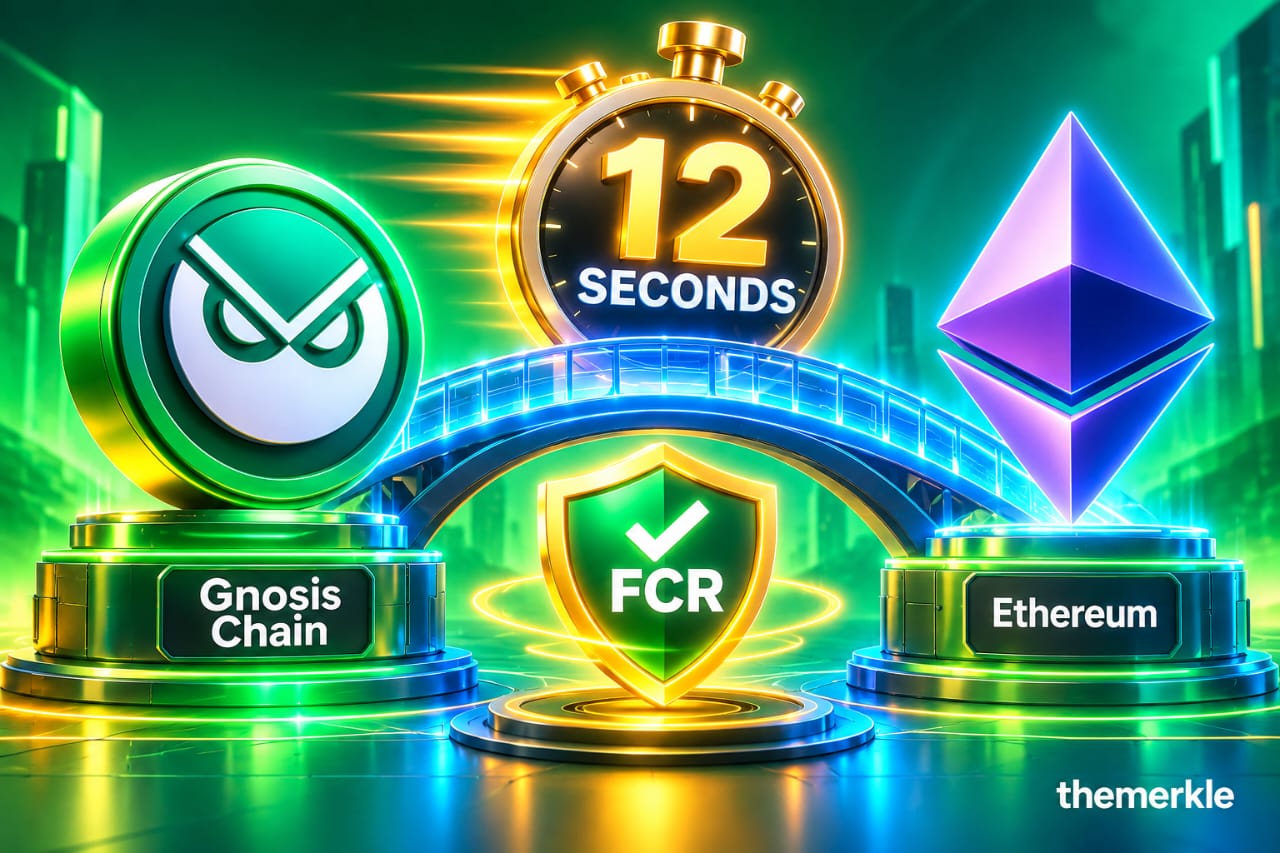
Gnosis Chain’s xDAI bridge and Omnibridge now use Ethereum’s Fast Confirmation Rule. Here is what the consensus spec says FCR confirms, and what 12-second bridging changes.
Twelve seconds is how long Ethereum takes to produce a single block. It is now also roughly how long a deposit takes to cross from Ethereum to Gnosis Chain. That raises a fair question: how can one block be trustworthy enough to move money on?
Gnosis Turns a 13-Minute Wait Into a 12-Second One
Gnosis has integrated Ethereum’s Fast Confirmation Rule (FCR) into its official bridges, the xDAI bridge and the Omnibridge. According to Gnosis Chain’s documentation, the change went live on October 8, 2026, and the project describes it as the first production system to implement FCR in the Ethereum ecosystem.
Until now, bridge validators waited for Ethereum finality before processing a deposit, and finality takes at least about 13 minutes. With FCR, validators can act as soon as the block holding a transfer is fast-confirmed, which usually happens within a slot, about 12 seconds after the block is proposed. Gnosis puts that reduction at roughly 98%.
The headline number is what grabs attention. The more interesting question, though, is what the rule actually promises.
What the Consensus Spec Actually Confirms
The reference point is the Bellatrix fast-confirmation spec in Ethereum’s consensus-specs repository. It is short, which makes it easy to follow. The spec introduces a function called get_safe_execution_block_hash, which returns the block hash of the execution payload included in the most recent confirmed block. That hash is then passed to the execution engine as the hash of a safe block.
Read plainly, FCR confirms a beacon block. The execution-layer transactions inside it, including a bridge deposit, count as safe because the block carrying them has been confirmed. It doesn’t confirm an individual transaction on its own, and it doesn’t claim the block is final. What it claims is that the block will not be reorganized.
Gnosis documents the application side. Fast-confirmed blocks appear through the existing safe block tag of the JSON-RPC API, so no hard fork or new endpoint is needed. Bridge validators simply ask their nodes what the safe block is.
How Attestation Counting Produces a Fast Confirmation
The mechanics boil down to a vote count. In every slot, validators publish attestations for the block they see as the head of the chain, and FCR tallies those attestations in real time. Once a block draws overwhelming support and passes additional robustness checks, it becomes fast-confirmed.
Finality works differently. A block finalizes after two epochs, and reverting it would require at least one third of all stake to be slashed. That guarantee is economic. FCR’s guarantee, by contrast, is conditional, resting on how the network behaves during that slot. This difference is worth understanding before anyone treats the two as interchangeable.
The Two Assumptions Behind the Guarantee
According to the Gnosis documentation, FCR relies on two assumptions. The first is network synchrony: attestations reach honest validators within about 8 seconds, before the slot ends. The second is an honest majority, with at least 75% of stake honest and participating. Finality tolerates an adversary with up to 33% of stake, so FCR’s margin is slightly narrower.
If both assumptions hold, a fast-confirmed block will be finalized. If they don’t, the most likely result is a liveness failure, where confirmation simply takes longer or falls back to finality. A safety failure, where a fast-confirmed block is reorged, would take extreme conditions.
Empirical evidence backs up how rare that is. ethPandaOps replayed a year of historical Ethereum beacon chain data through FCR and recorded zero false confirmations. That result is encouraging, although a replay is not the same as facing a live adversary.
The Safeguards Gnosis Built Around the Bridge
Gnosis didn’t just flip a switch. The bridge contracts are unchanged, and only the moment at which validators consider an Ethereum block safe has shifted. Each bridge validator runs its own Ethereum nodes rather than relying on third-party RPC providers, and the validators run different consensus clients so that no single client holds a majority. As a result, a bug in one implementation can’t push the bridge into acting on a false confirmation.
During Ethereum hardforks or periods of instability, the bridge falls back to waiting for finality. A public FCR monitor also watches the nodes every slot. It raises a critical alert if a fast-confirmed block is replaced at the same height, which can be caught minutes before finality, and again if the finalized block differs from the fast-confirmed one.
That monitoring detail shows the team took the failure case seriously. Any rule that trades a longer wait for a conditional guarantee needs a way to notice when the condition fails.
Why Twelve-Second Bridging Matters for Users
For users, the change is mostly invisible except for the clock. All transfers from Ethereum now use FCR by default, and nothing changes in how the bridge is used. Because xDAI is the gas token on Gnosis Chain, a faster deposit also means a new user can start transacting on the network almost immediately after funding.
There are limits worth stating. The speedup runs in one direction only, since transfers from Gnosis Chain to Ethereum still wait for Gnosis block finality, about five minutes. Some transfers will also take longer than 12 seconds, because validator processing, signature thresholds and client logic all add time. Gnosis separately notes that FCR is unrelated to its planned move to an Ethereum Economic Zone rollup.
Overall, this is a careful, well-instrumented use of a new primitive rather than a blanket claim that waiting for finality is obsolete. FCR makes a trade explicit: a conditional guarantee in seconds instead of a slashing-backed one in minutes. For bridging, where a long delay is often the bigger cost, many users will take that trade. Whether other bridges and exchanges follow will show how much confidence the wider ecosystem puts in the rule.
Disclosure: This is not trading or investment advice. Always do your research before buying any cryptocurrency or investing in any services.
Follow us on Twitter @themerklehash to stay updated with the latest Crypto, NFT, AI, Cybersecurity, and Metaverse news!