
Key Takeaways
- Price manipulation attacks are accelerating, with 32 exploits already recorded in 2026.
- Illiquid tokens and vulnerable oracles are creating growing risks for crypto asset lending protocols.
- Even users who don’t hold manipulated tokens can suffer losses when attacks leave lending pools with bad debt.
These attacks occur when an attacker artificially pumps the price of an illiquid crypto asset, then uses it as collateral to borrow other assets from a lending protocol. As the price of the collateral crashes immediately, the attacker simply walks away with the borrowed hard asset, abandoning their now-worthless collateral without needing to repay the debt.
Two Weak Links
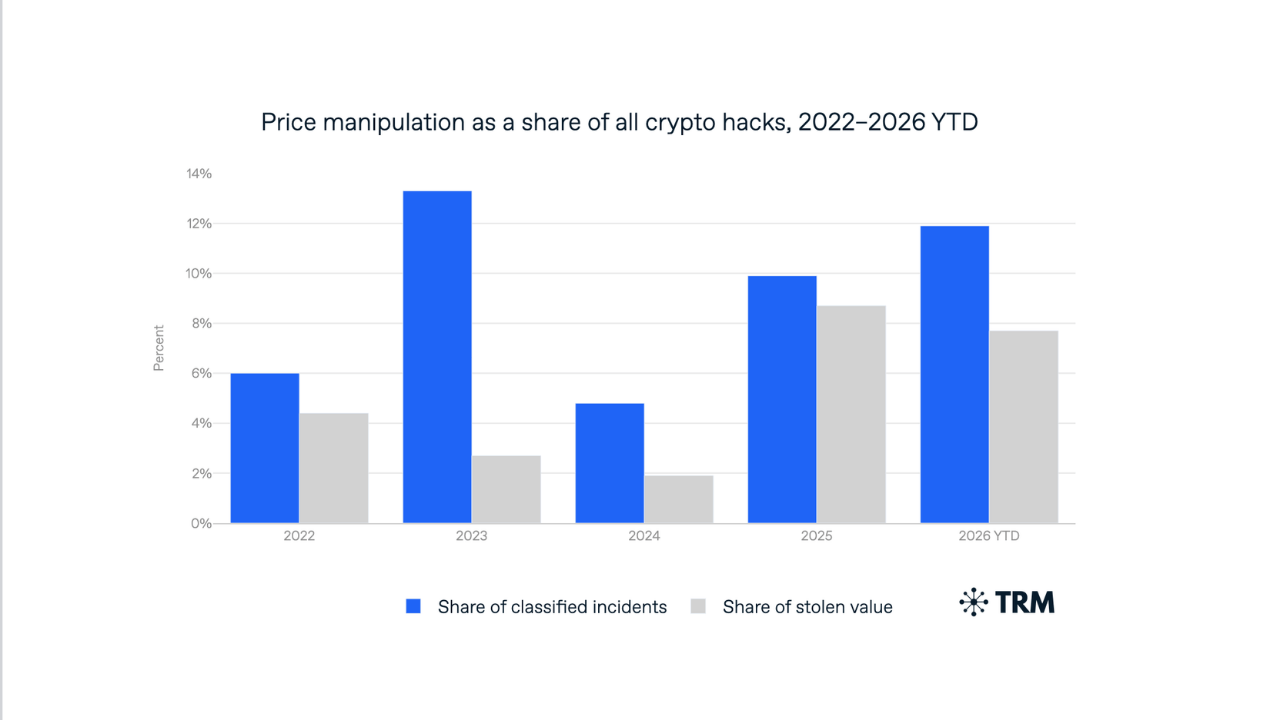
Blockchain intelligence firm TRM Labs said they’ve registered 32 of this type of price-manipulation exploit so far in 2026, more than in any previous year. These numbers have been growing for the third year in a row, while last year, “only” 12 such cases were recorded. According to the researchers, price manipulation now accounts for about one in eight hacks, up from one in 17 in 2022. However, the share of stolen value has remained relatively flat, suggesting that these attacks have possibly become cheaper and more repeatable, while the required capital is easily accessible via flash loans.
“An attacker who can convince a protocol that a near-worthless asset is valuable never has to touch its code. All it takes is a token with a thin market and an oracle that prices it off that market,” TRM Labs said.
Besides the easily manipulated price, another weak link here is oracles, or special programs that take the value of collateral from the market. At the same time, it’s relatively simple to pump the price of a token with little trading volume.
The Total Attackable Market Is Growing
This rise in this type of manipulation is also supported by the expansion of the crypto asset-backed lending market.
Per Defillama data, which lists more than 570 lending protocols, in the past two years, in USD terms, total value locked in these platforms has increased around 56%, to almost $50 billion, while the value of active loans almost doubled, nearing $29 billion. Moreover, the attacks this year have accelerated despite the fact that, in USD terms, this market has experienced a sharp drop from its record highs in October 2025, but has been recovering since August amid the broader crypto asset price rally.

The most recent and one of the biggest attacks happened just a few days ago. As reported by Bitcoin.com News, a money market protocol, Tectonic, lost over $70 million after an attacker inflated TONIC’s price. Per TRM Labs, the price of the token was inflated 100x in around 20 minutes. However, the Cronos network, the layer one (L1) blockchain that powers Tectonic, managed to roll back the chain, leaving the attacker with “only” around $6 million worth of assets.
Meanwhile, just three days before Tectonic, attackers manipulated MAMO oracle prices to drain about $8.7 million in assets from Moonwell, another lending protocol.
Therefore, when you’re buying this type of manipulated rally, you’re getting right into a trap, becoming the attacker’s way out, much like buying into a rally in a pump-and-dump scheme.
A Sour Mango Precedent
While it might be difficult to distinguish whether a token rallies due to organic growth, a pump-and-dump scheme, or oracle price manipulation, a crypto asset holder might get hurt even if they don’t own the manipulated asset but are using the attacked protocol, which now has to deal with bad debt. In that case, their ability to withdraw their money would depend on the assets the affected lending pool still has. These chances would also depend on how successful the operators of the targeted protocols are in freezing the attackers’ addresses, reversing transactions, or negotiating with the attacker.
Meanwhile, turning to law enforcement in an attempt to recover these losses might also be troublesome. In May last year, in a case involving a similar attack on Mango Markets, a U.S. judge ruled that the platform had no rules and no one testified that users understood borrowing to reflect an intent to repay, while the platform itself is permissionless and automatic, and there was no prohibition against manipulation. Either way, the judge vacated Avram Eisenberg’s fraud and manipulation charges as prosecutors had failed to prove that the case should be tried in New York. Prosecutors have since appealed.
Inconvenient Fact and Collateral Damage
Another inconvenient fact for both the lending protocols and their users is the existing governance conflict. For example, TONIC is Tectonic’s own governance token that is accepted as collateral by the same protocol. At the same time, risk parameters are set by the same people who benefit from the token’s price rise. However, they’re also affected by the price crash if they’re not quick enough to liquidate their positions.
Hence, as investments in crypto assets are mostly seen as gambling, increasing risks, especially when it comes to small, illiquid tokens, might provide an even greater adrenaline rush for those who are here for quick profits and a thrill.
However, it also affects those who were not trying to gamble and are just lending their hard assets, trying to earn a much smaller but more predictable yield.