

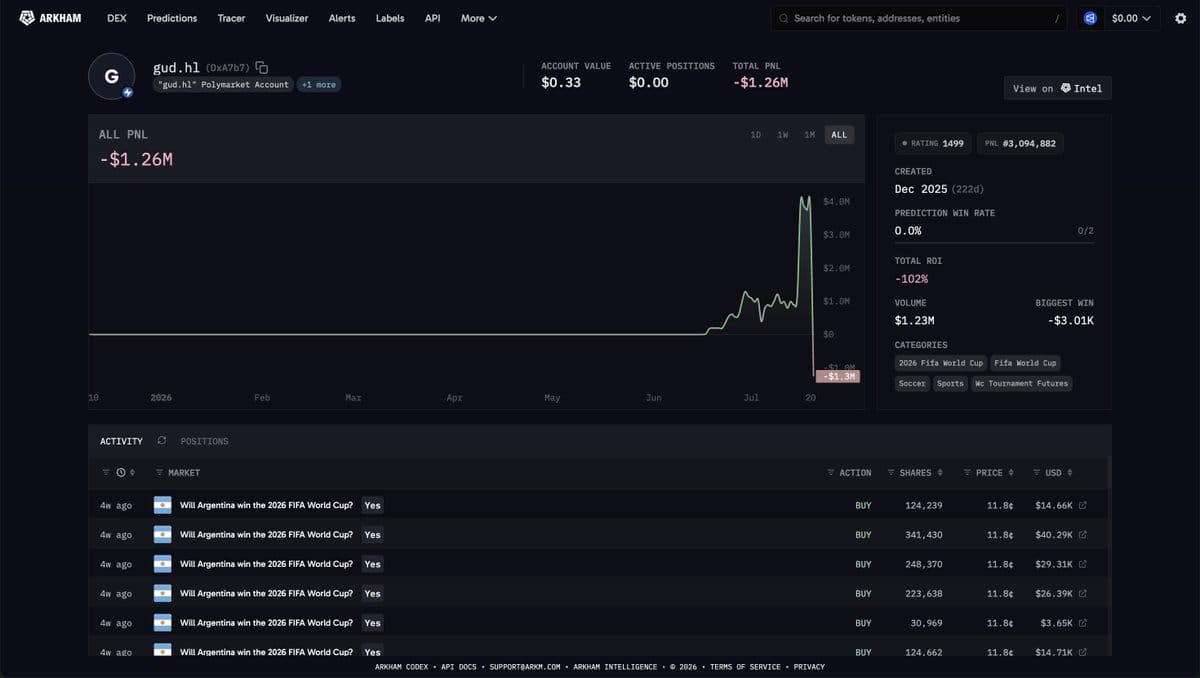
Spain won the 2026 World Cup with a dramatic 1-0 extra-time victory over Argentina, leaving trader gud.hl empty-handed after risking their entire $5.2 million position on an Argentine win.
While crypto traders get wrecked by leverage on bad calls all the time, losing a fortune on a single football match is a whole different level of pain to watch unfold. According to an Arkham post on X tracking the position, the bettor lost everything the moment the final whistle blew.
What makes this loss sting even more is where that money came from. gud.hl had reportedly staked almost the entirety of his Hyperliquid PnL on Argentina winning it all. That’s not a side bet funded with disposable cash. That’s converting real trading profits into a single binary outcome and watching it evaporate in extra time. Whether he claws any of it back from here is genuinely an open question, and I don’t think anyone should assume he will.
A Tournament That Made Betting History
This wasn’t an isolated bad bet in a quiet market. The scale of money moving through prediction platforms during this World Cup is staggering on its own. FIFA reportedly earned more than $9 billion from the 2026 tournament, making it the most lucrative sporting event in history by that measure. Layered on top of that is what happened across crypto betting platforms over the five weeks the tournament ran, and I think the numbers here matter more than the headline figure from FIFA itself.
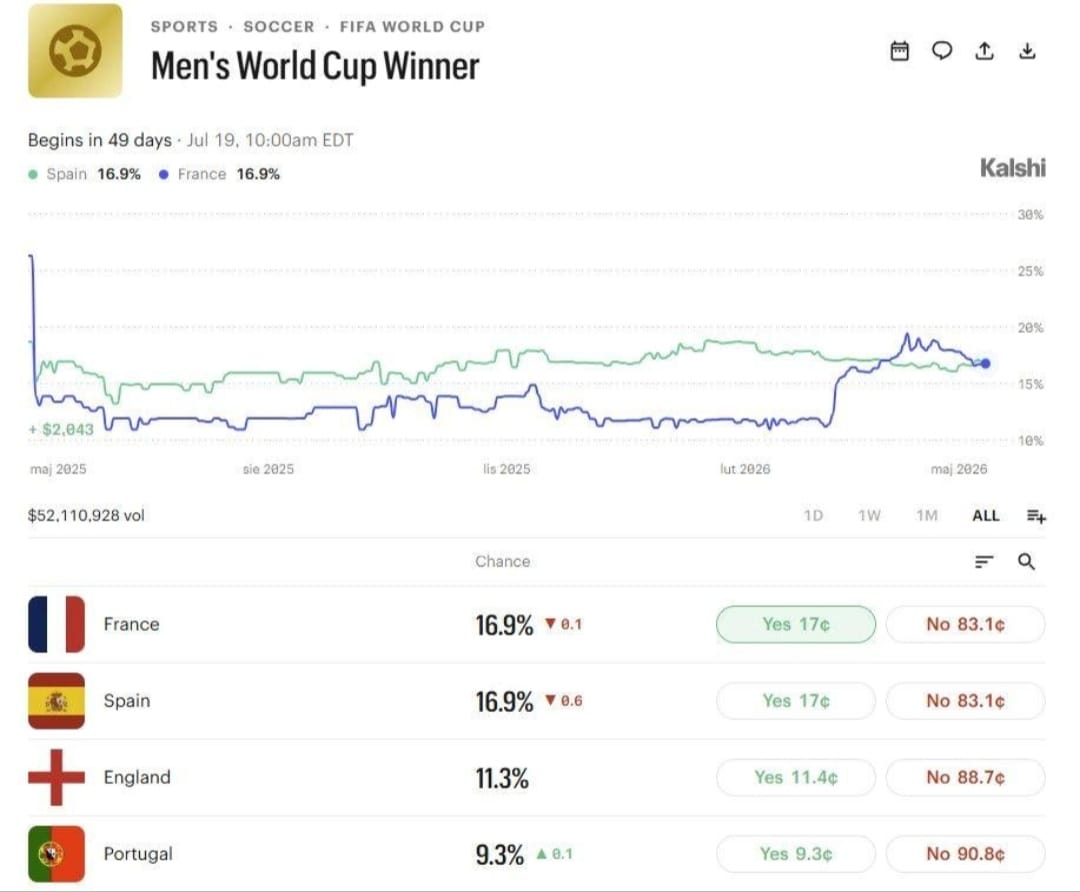
Polymarket’s World Cup winner market alone did more than $4 billion in trading volume, a number no market in the platform’s history has come close to touching. Kalshi’s winner market crossed $1.2 billion, setting a new record for that platform as well. At peak activity, monthly prediction market volume across the sector hit more than $50 billion. I think that last figure is the one worth sitting with the longest. Traditional sportsbooks spent decades building the infrastructure, brand trust, and user base needed to hit numbers like that. Prediction markets did it in five weeks.
Millions Of New Users, One Tournament
The user growth numbers are just as striking as the volume figures. Kalshi added three million new users during the tournament window alone. I think that’s worth putting in blunt terms: a single football event brought more new users onto a platform than most entire blockchain networks have managed to onboard across their whole existence. That’s not a knock on crypto adoption efforts generally, it’s a reflection of just how much pull a genuinely global sporting event has when there’s real money and a clear binary outcome attached to it.
The Traders Who Made It And The Ones Who Didn’t
Alongside gud.hl’s loss, the tournament produced its share of dramatic wins and losses on both sides of the same trade. One trader turned a $4 million position against Spain into $9 million, according to a post detailing the trade, a genuinely massive payout for correctly fading the eventual champion at the right moment. Another trader lost $11.6 million over just ten days by consistently betting the wrong way as the tournament progressed.
I think these numbers, taken together, tell a more honest story than any single headline result. For every gud.hl losing millions on Argentina, there was someone else making millions fading the same outcome. That’s the nature of any market this size and this liquid, but seeing it play out around a World Cup final specifically, rather than a purely financial event, makes the stakes feel more visceral than a typical crypto trading story usually does.
Why This Tournament Became A Crypto Story
I don’t think it’s an accident that a football tournament became one of the biggest crypto liquidity events of the year. Prediction markets thrive on clear, verifiable, binary outcomes, and a World Cup final is about as clean an example of that as exists. There’s no ambiguity about who won. There’s a fixed date. There’s global attention. Every ingredient that makes a prediction market function well was present here at a scale most other events simply can’t replicate.
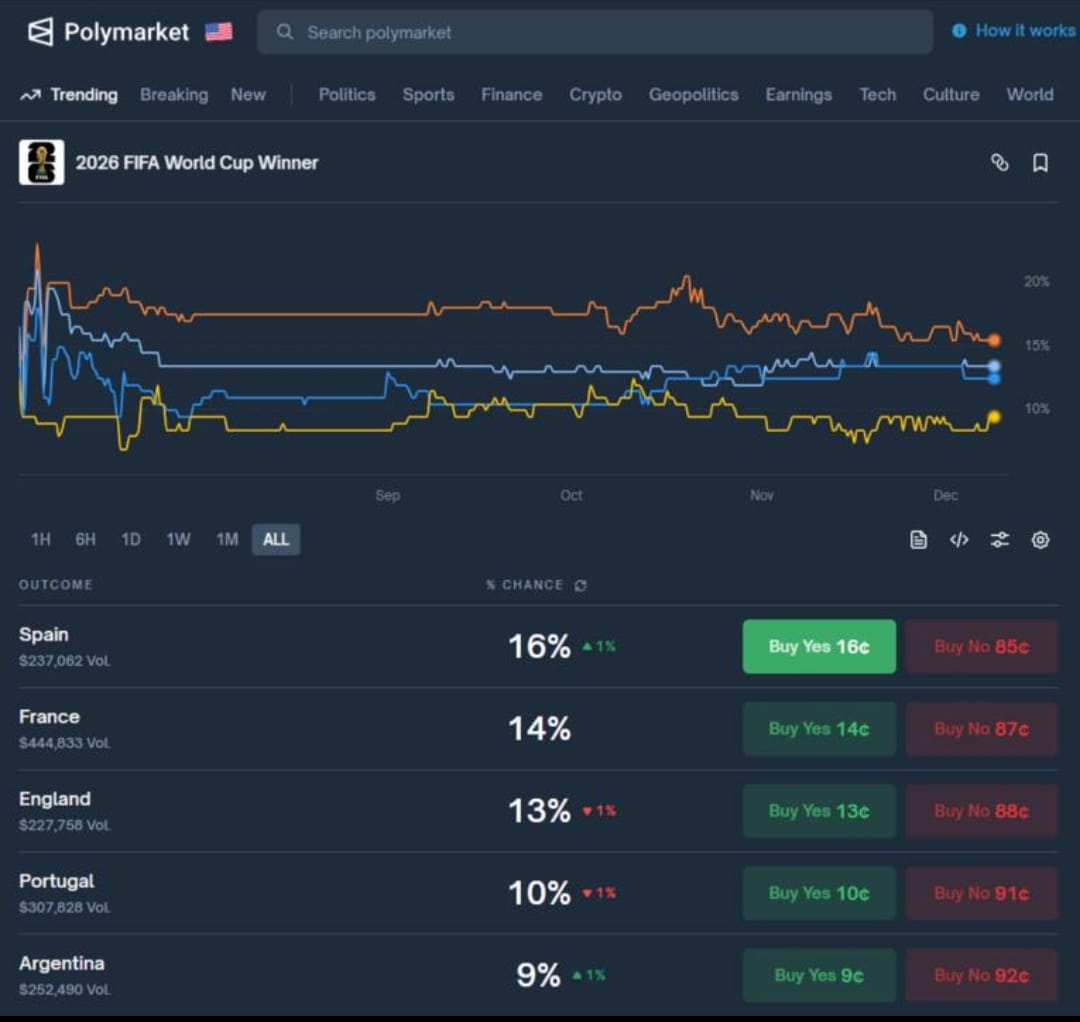
What I find genuinely notable is how quickly the infrastructure absorbed that demand. $50 billion in monthly volume at peak isn’t a number these platforms were built to handle from day one. The fact that Polymarket and Kalshi both processed record-breaking volume without the kind of visible platform failures that have plagued smaller markets during high-traffic moments in the past says something about how far this infrastructure has actually matured.
What This Means Going Forward
I think the real story coming out of this World Cup isn’t gud.hl’s $5.2 million loss, as brutal as that is for him personally. It’s that prediction markets just proved, at massive scale, that they can absorb the kind of volume and user growth that used to be the exclusive domain of traditional sportsbooks and major exchanges. Three million new users and $50 billion in monthly volume during a single tournament isn’t a fluke. It’s a signal that the next major global sporting event, whatever it is, is going to see even more capital flow through these platforms than this one did.
For gud.hl, the more immediate question is simpler and much more personal: whether a Hyperliquid PnL that took real time and skill to build can be rebuilt after being wiped out on a single bet. Markets like these can turn a good trader’s fortunes around fast in either direction. Whether this becomes a comeback story or a cautionary tale is something only the next few months will actually answer.
Disclosure: This is not trading or investment advice. Always do your research before buying any cryptocurrency or investing in any services.
Follow us on Twitter @themerklehash to stay updated with the latest Crypto, NFT, AI, Cybersecurity, and Metaverse news!