
Crypto platforms Celsius and Voyager Digital filed for bankruptcy in July 2022. Both froze customer accounts first, which left users unable to reach their assets.
The filings raised a basic question. If an exchange fails, what happens to the crypto people had stored on it?
This article uses the figures reported by CNBC in July 2022 to lay out the facts. It covers the debts involved, the protections that exist for bank and broker customers, and where crypto users stand when a platform fails.
The short answer from legal experts is that recovery is slow and often partial. The sections below explain why.
Each section includes a table and a chart. All figures come from the CNBC report unless the text says they were calculated.
How Celsius and Voyager Reached Bankruptcy
Celsius and Voyager Digital are crypto trading and lending firms. Both filed for bankruptcy in July 2022. Both had frozen client accounts before they filed, which left users with assets they could not reach.
The freezes followed a rush of withdrawals. That rush caused liquidity problems at both firms. Liquidity is the cash, or assets that turn into cash quickly, that a firm needs to pay people back on demand.
Celsius operated much like a bank. It took customer deposits and then lent them out. It also placed money in so-called decentralized finance products to earn high yields.
Voyager had a similar model. It was caught up in the collapse of Three Arrows Capital, a high-profile crypto hedge fund. Three Arrows defaulted on a $660 million loan from Voyager and then failed itself.
These links between firms left the market open to contagion. Contagion means one failure spreading to the next. Major firms fell one after another as a plunge in token prices unwound excess leverage in the system.
Leverage means using borrowed money to make larger bets. When prices drop, leveraged positions can lose value fast. Lenders then want their money back, and that pressure moves through the chain of firms.
Both companies hired the law firm Kirkland & Ellis to represent them in court. Both filed for Chapter 11, a form of bankruptcy protection that lets a firm restructure its debts. The aim is to leave a viable business at the end of the process.
The table below compares the two firms as described in the CNBC report.
| Item | Celsius | Voyager Digital |
|---|---|---|
| Business type | Crypto trading and lending | Crypto trading and lending |
| Business model | Took deposits, lent them out, used DeFi products | Similar model to Celsius |
| Trigger | Rush of withdrawals and liquidity problems | Three Arrows default on $660M loan |
| Customer accounts | Frozen | Frozen |
| Bankruptcy type | Chapter 11 | Chapter 11 |
| Law firm | Kirkland & Ellis | Kirkland & Ellis |
Celsius by the Numbers
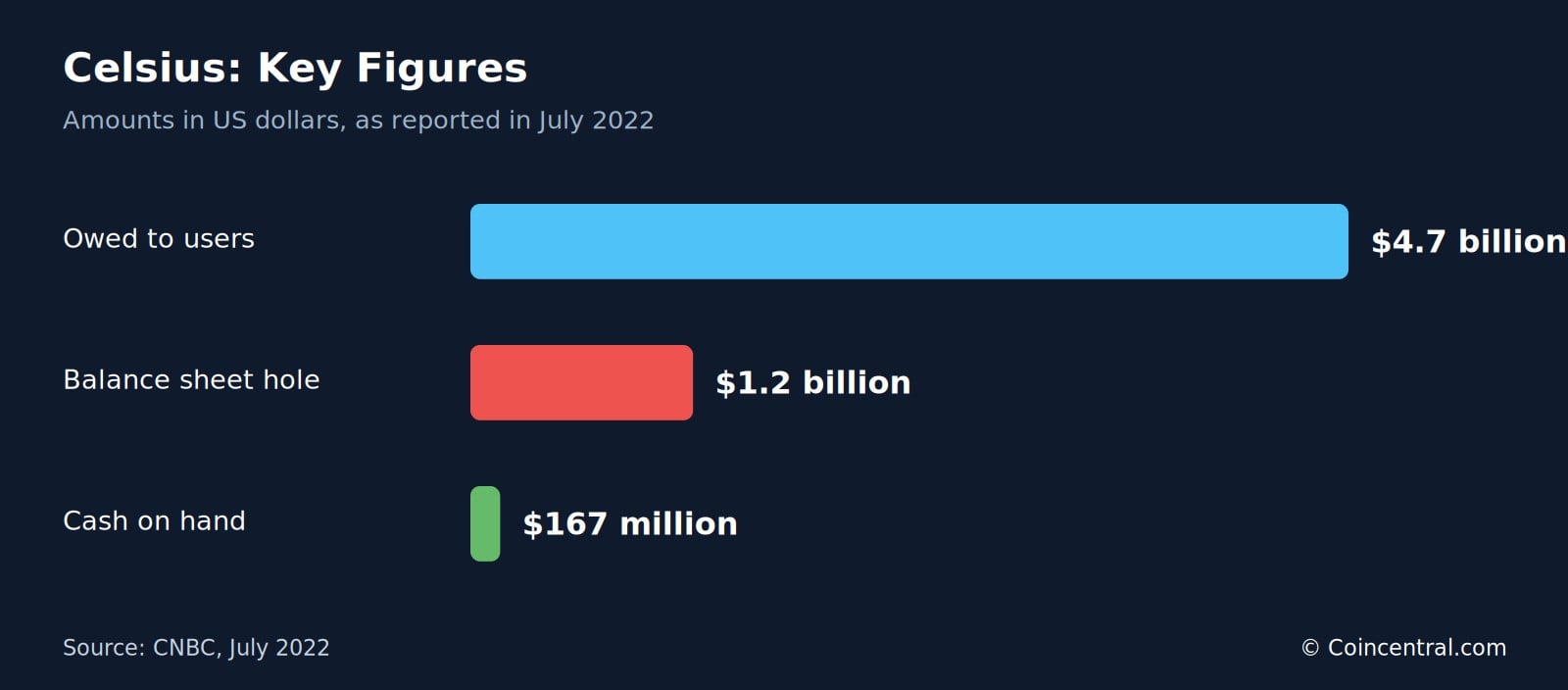
Celsius filed for Chapter 11 protection in the week before the CNBC report. The filing showed a $1.2 billion hole in its balance sheet. A balance sheet hole means the firm’s assets are worth less than what it owes.
The firm owed users around $4.7 billion. That is the amount customers had placed with the platform. Together, the two figures show how far the firm’s assets had fallen short.
Celsius said it had $167 million in cash on hand. By our calculation, that is about 3.6 percent of the $4.7 billion owed to users. The $1.2 billion gap equals about 26 percent of that same amount.
Even with that cash, Celsius was not letting customers withdraw. It also had not said when withdrawals might reopen. Users therefore had no timeline for getting funds back.
The firm’s terms of use add to the uncertainty. They state that any funds deposited with the firm “may not be recoverable” if the firm goes bankrupt. Users agreed to this language when they opened accounts.
Celsius is one case, but it shows the scale of the problem. A gap of this size raises the question of how the remaining assets will be shared among those owed money. The answer depends on what the court process finds and how assets are valued.
The table lists the main figures reported for Celsius. The chart shows how they compare.
| Figure | Amount | What it means |
|---|---|---|
| Owed to users | About $4.7 billion | Total the firm owed to customers |
| Balance sheet hole | $1.2 billion | Assets fall short of what is owed |
| Cash on hand | $167 million | Cash the firm said it held |
| Cash as share of user debt | About 3.6% (calculated) | $167M divided by $4.7B |
| Gap as share of user debt | About 26% (calculated) | $1.2B divided by $4.7B |
What Protections Exist for Bank and Broker Customers
Cryptocurrencies are not regulated in the way banks and brokers are. That means people do not get the same protections they would on money held in a bank or shares held at a brokerage. The gap matters most when a firm fails.
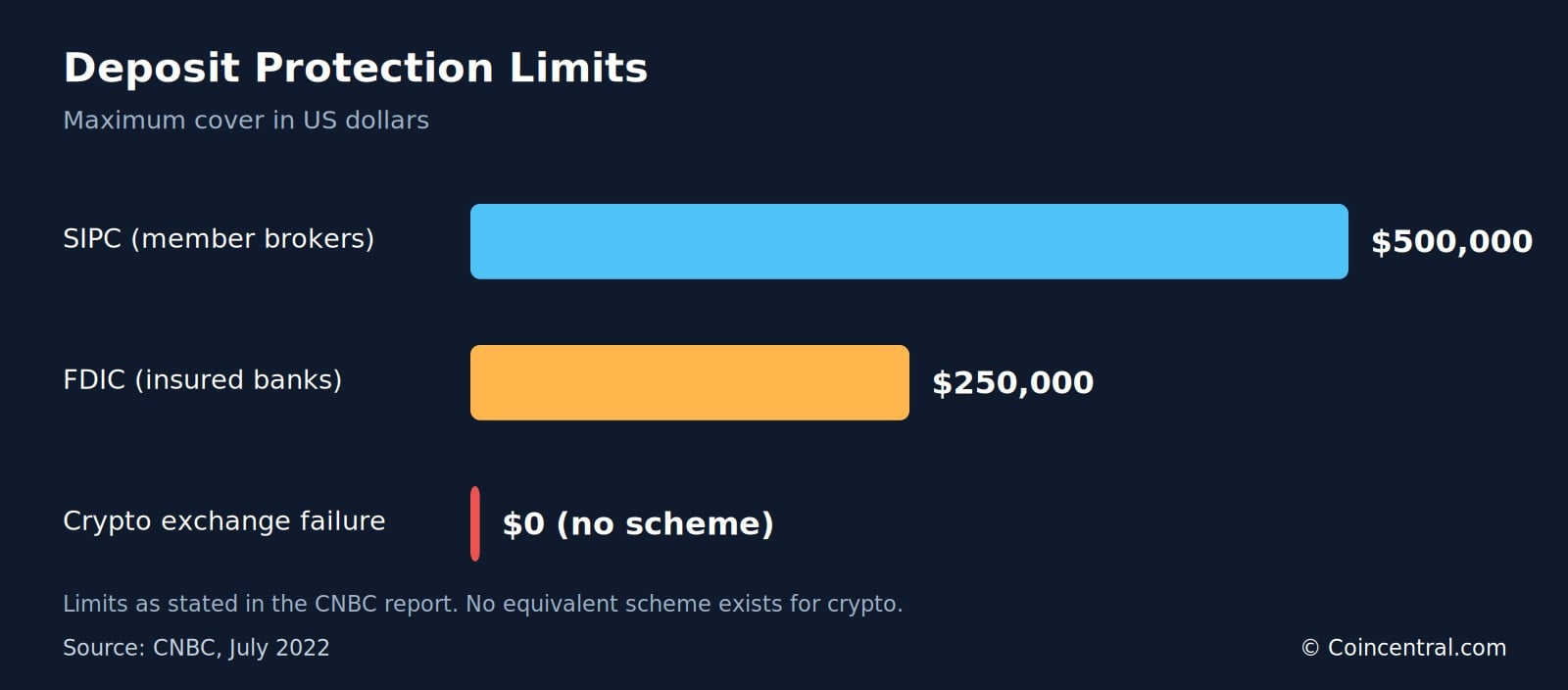
In the United States, the Securities Investor Protection Corporation, known as SIPC, insures traders up to $500,000 in cash and securities. This applies if a member broker runs into financial difficulties. It covers brokerage customers, not crypto exchange users.
The Federal Deposit Insurance Corporation, known as the FDIC, protects bank depositors up to $250,000 if an insured lender fails. Similar schemes exist in the U.K. and the European Union. Each is tied to a regulated type of firm.
No laws govern cryptoassets in the same way. As a result, there is no guarantee investors could recoup their funds if an exchange froze an account or collapsed completely. The risk is higher for people who hold large balances in one place.
Daniel Besikof, a partner at Loeb & Loeb, told CNBC that no such scheme exists for crypto at this point. He added that it would not surprise him if one appears down the line. He also said the failures will ramp up calls for enhanced regulation.
Voyager made a related claim about FDIC cover. It said customer dollars were kept in an FDIC-insured account at Metropolitan Commercial Bank in New York. Legal experts and the bank itself contested this claim.
The FDIC only protects funds when a bank fails. It does not protect funds if a crypto exchange fails. Voyager said it was working through a “reconciliation and fraud prevention process” with its banking partner, after which users would regain access to their cash.
Put simply, the cover follows the type of firm and not the type of asset. A crypto exchange does not fall under the bank or broker schemes. The table shows what each type of cover applies to.
| Protection | Covers | Limit | Applies to a crypto exchange failure? |
|---|---|---|---|
| SIPC | Member brokers | $500,000 in cash and securities | No |
| FDIC | Insured banks | $250,000 for depositors | No |
| U.K. and EU schemes | Regulated firms | Similar schemes in place | No |
| Crypto exchange scheme | None at this point | Not applicable | No scheme exists |
Who Owns the Assets in a Failed Exchange?
A key question in any failure is who owns the assets held on a platform. Many users assume that the coins in their account are still theirs. Lawyers say that may not hold in a bankruptcy.
Centralized crypto platforms can mix different clients’ funds together. According to Daniel Saval, a lawyer with Kobre & Kim, they may then use the pooled money to make risky bets. This mixing is called commingling.
Commingling may lead a court to rule that the assets are the property of the exchange, not its users. Saval said users may be surprised to learn this. In his words, the crypto and funds in their accounts may not be considered their own property.
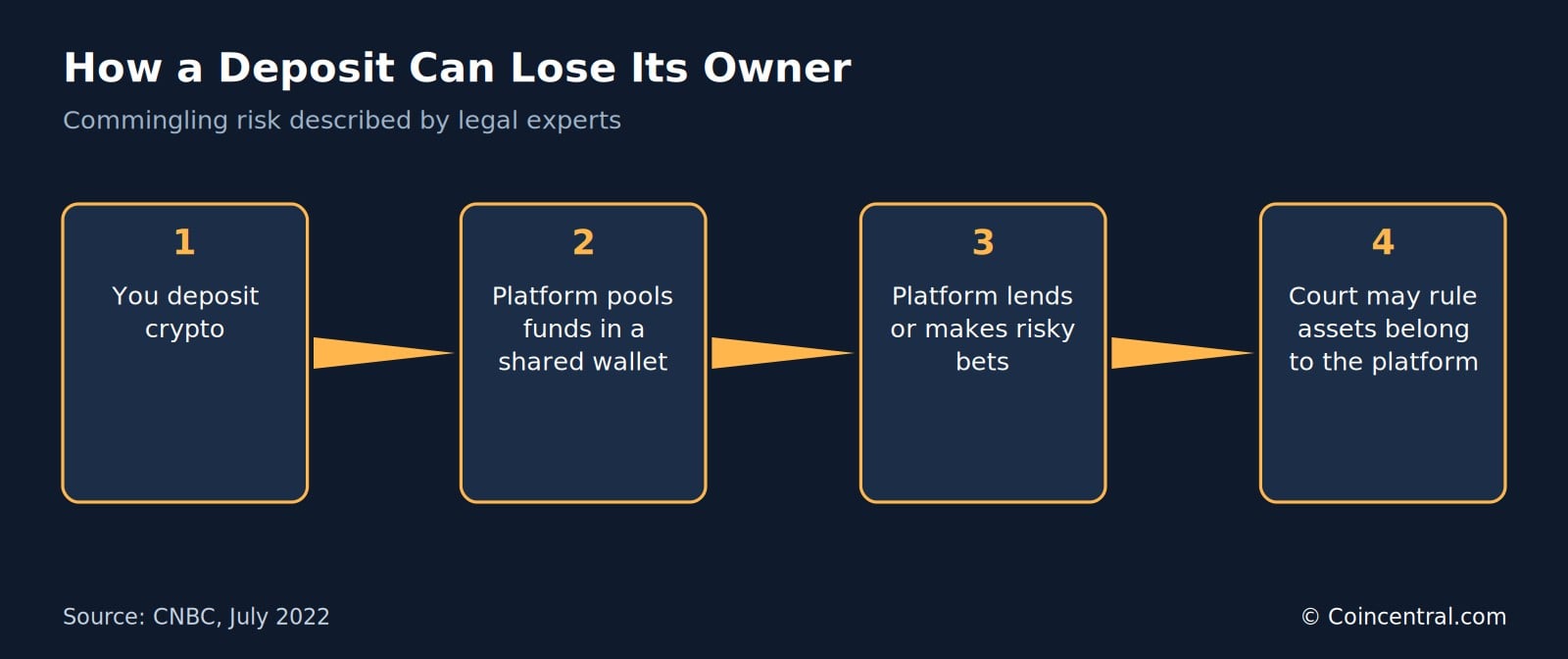
Exchanges will often pool different customers’ crypto and funds in the same storage wallet or account. That setup makes it harder to show which coins belong to which user. It can also blur the line between customer money and company money.
Besikof said what happens to customers’ funds depends a lot on the company’s user agreement. It also depends on how the company used the assets. These two factors can differ from firm to firm.
The Celsius terms of use are one example. They say deposited funds may not be recoverable in a bankruptcy. Coinbase took a similar position in a May regulatory filing, saying its users would be treated as “general unsecured creditors” if it went bankrupt.
The table lists the factors that experts say shape ownership questions. The chart shows how a deposit can move from a user’s account to a court ruling.
| Factor | What the experts said |
|---|---|
| User agreement | Outcome depends a lot on the terms users accepted |
| Use of assets | Outcome depends on how the company used customer funds |
| Commingling | Pooled funds may be ruled the property of the exchange |
| Storage setup | Exchanges often pool customer crypto in one wallet or account |
| Celsius terms | Funds deposited may not be recoverable in bankruptcy |
Where Customers Stand in the Payout Line
Celsius and Voyager filed for Chapter 11. This form of bankruptcy protection lets a firm restructure its debts. Courts then decide how to share what is available among those owed money.
Legal experts said it was likely that users would be treated as unsecured creditors. That label puts them in the same group as a business’s suppliers and contractors. It is not a favorable place in the line.
Customers would likely be at the back of a long queue. They would wait behind banks, employees and tax authorities. Dustin Palmer, managing director at Berkeley Research Group, explained the order.
He said that in general, most customers of crypto exchanges are unsecured creditors. When an exchange collapses, secured creditors are paid back first, along with legal fees. Customers are then paid last, on a pro rata basis.
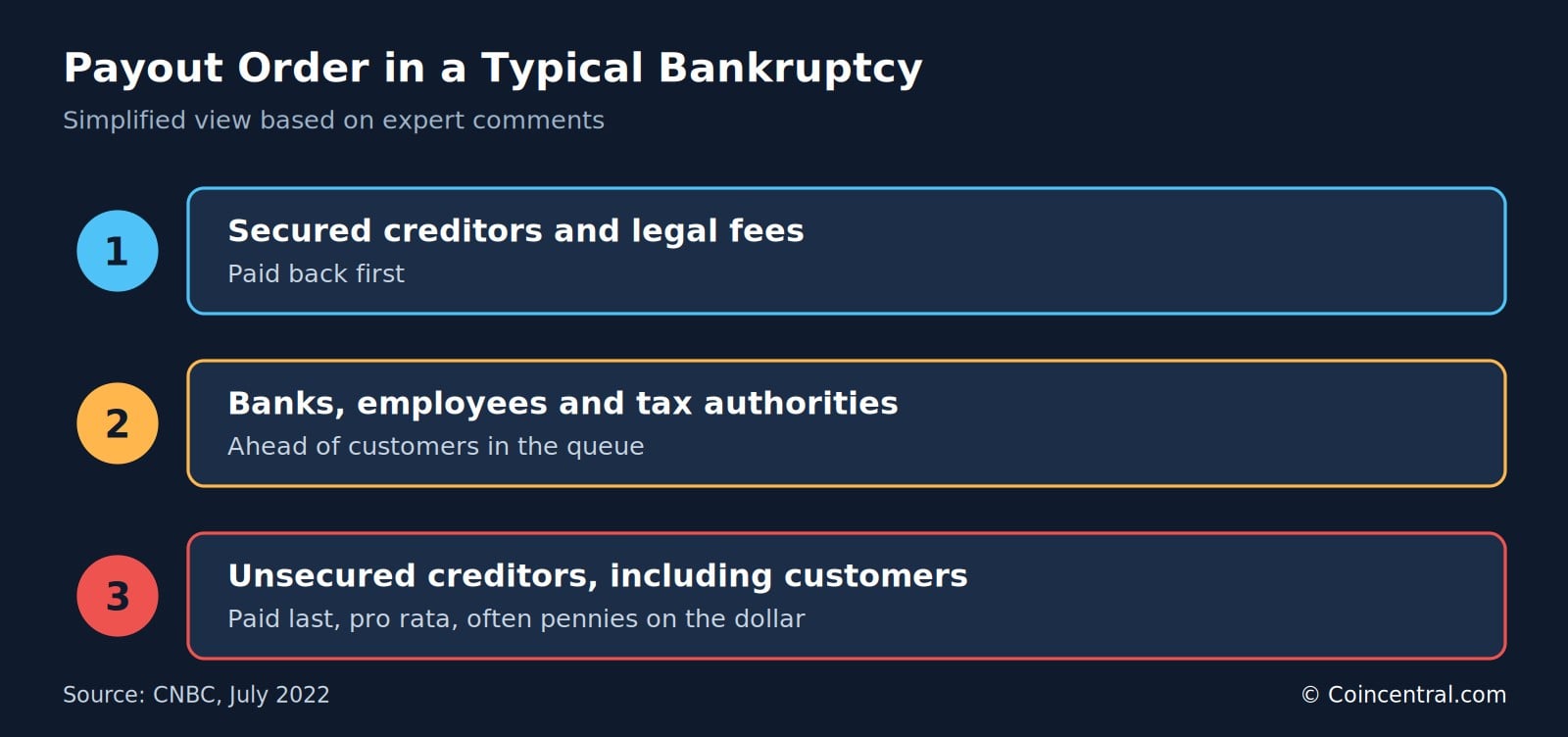
Pro rata means each creditor gets the same share of what remains, in proportion to what they are owed. If the money left is small, each share is small. Palmer said that in a typical bankruptcy, this is pennies on the dollar.
Saval added that recoveries may be diluted further by other unsecured creditors. These include vendors, lessors and litigation claimants. Each of those groups competes for the same pool of money.
Coinbase told investors in a May filing that its users would be general unsecured creditors if it went bankrupt. That shows the issue is not limited to firms that have already failed. It reflects how customer claims are generally classed.
A secured creditor holds a claim backed by specific property. An unsecured creditor has no such backing, so its claim depends on what is left. This difference explains why customers sit near the back.
The table and chart show the order described by the experts. The ranking is a simplified view based on the CNBC report, not a full legal ranking.
| Position | Group | Notes |
|---|---|---|
| 1 | Secured creditors and legal fees | Paid back first |
| 2 | Banks, employees and tax authorities | Ahead of customers in the queue |
| 3 | Unsecured creditors, including crypto customers | Paid last, pro rata |
| Also in line 3 | Vendors, lessors and litigation claimants | May dilute customer recoveries |
How Long Does It Take to Get Paid?
Time is the second problem for users. Palmer said customers will likely have to wait until the full bankruptcy process is complete before they receive payment. Bankruptcy usually lasts years.
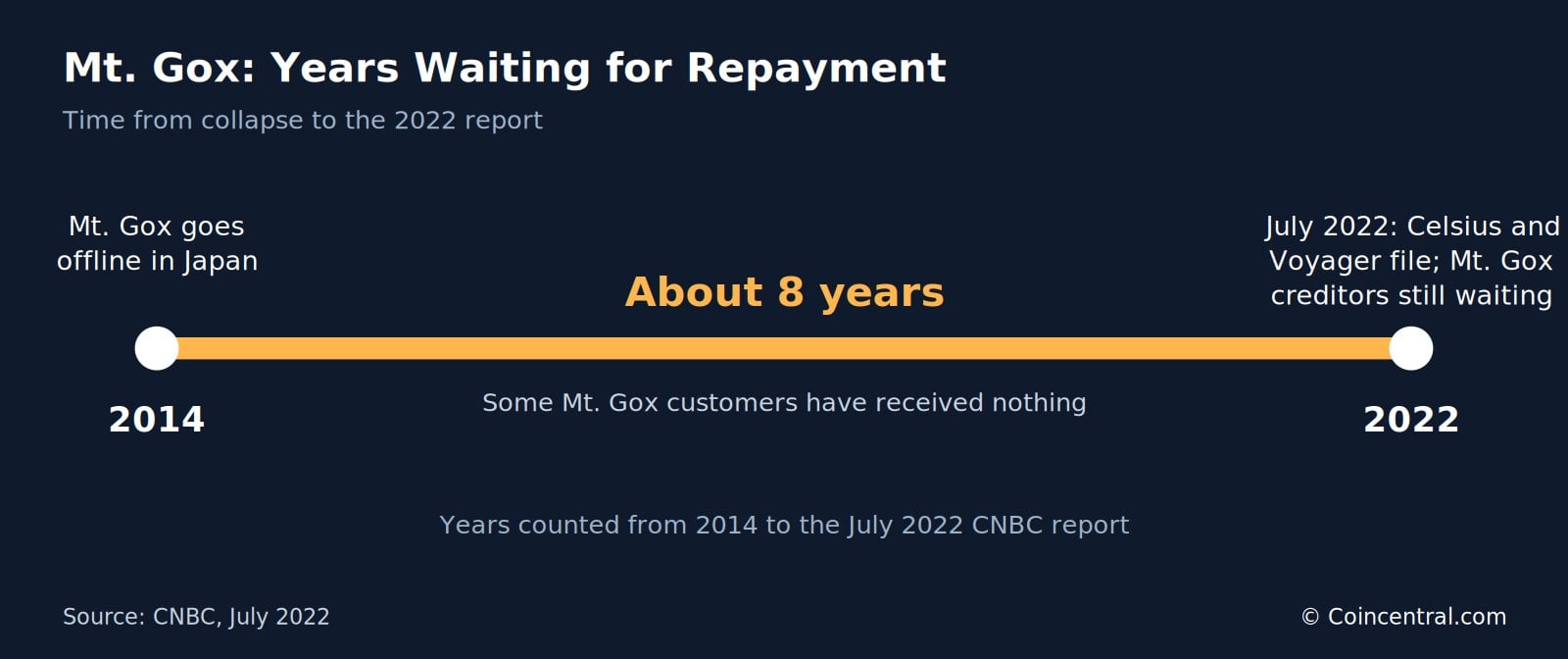
He pointed to past cases. “Lehman took years,” he said. He added that some Mt. Gox customers have still not received any payment.
Mt. Gox was a crypto exchange in Japan that went offline in 2014. As of the CNBC report in July 2022, its creditors were still waiting to be repaid billions of dollars’ worth of cryptocurrency. That is a wait of about eight years.
Crypto firms have filed for bankruptcy overseas before. Mt. Gox in Japan is one example. A crypto exchange bankruptcy of this kind was unprecedented in the U.S. at the time.
That lack of precedent leaves open questions. It is not yet entirely clear what happens to customer funds when an exchange fails in the U.S. Courts will set the early examples.
Voyager laid out a plan to repay users. It would reimburse them with crypto in their accounts, Voyager shares and the company’s own token. It would also pass on any debt recovered from Three Arrows Capital.
Besikof said investors holding crypto through Voyager and Celsius were in a difficult position. Their accounts were frozen, their lawsuits stayed, and the value and timing of any recovery were unknown. He added that there was a lot of work to do in bankruptcy court before these issues are resolved.
Each of these cases moves at its own pace. The table summarizes each case as reported in July 2022.
| Case | Where | Status as reported in July 2022 |
|---|---|---|
| Mt. Gox | Japan | Offline since 2014; creditors still waiting for billions in crypto |
| Celsius | U.S. | Chapter 11 filed; withdrawals frozen, no reopening date |
| Voyager Digital | U.S. | Chapter 11 filed; plan to repay in crypto, shares and token |
| Lehman | U.S. | Cited by Palmer as a case that took years |
Can You Protect Your Crypto?
Some investors move crypto off exchanges into self-custody wallets. In this setup, the owner is responsible for their own private key. A private key is a secret password needed to access a crypto wallet.
Self-custody removes the risk that a platform freezes your account. The coins are also no longer mixed with other customers’ funds in an exchange’s shared wallet. Control moves to the owner.
The move comes with its own risks, however. If a holder loses their private key, they may never be able to recover their funds. The risk shifts from the platform to the person.
There are countless examples of people who lost hard drives or USB sticks containing crypto worth millions. These cases show how much weight rests on one device or one password. Careful storage matters.
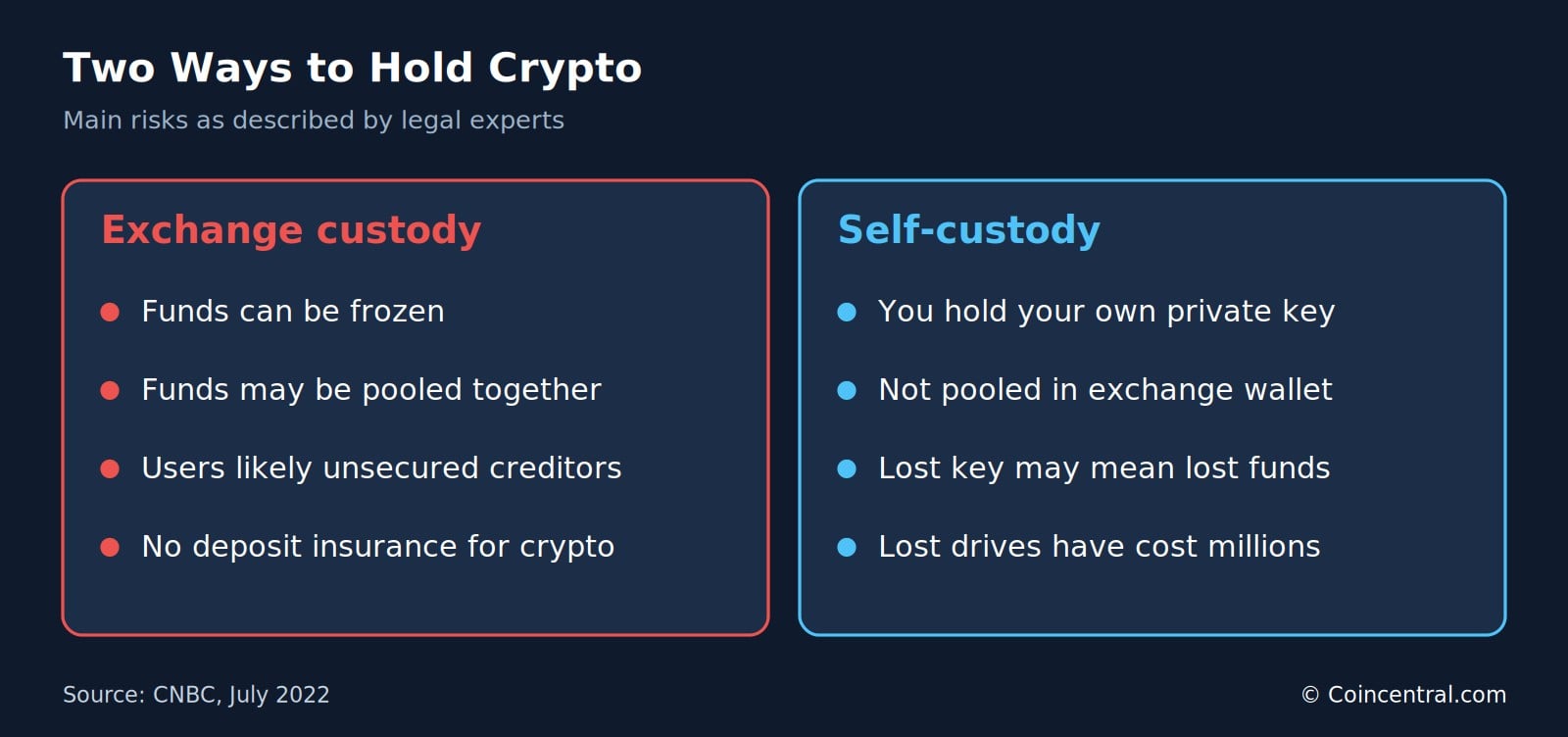
Both options carry risk. On an exchange, the risks are freezes, pooling and a place at the back of the payout line. In self-custody, the main risk is losing the key.
Regulation may change the picture. Besikof said the recent failures will ramp up calls for enhanced regulation. He said it would not surprise him if a protection scheme appears later.
For now, the facts from the CNBC report are clear. Crypto held on a platform is not insured like bank deposits or brokerage assets. Users of a failed platform are likely to be paid last, slowly, and in part.
Readers should keep in mind that these figures date from July 2022. Court outcomes and rules may have changed since then. Check current sources before making decisions about where to hold crypto. This article is not financial advice.
| Option | Main risk | Who controls access |
|---|---|---|
| Exchange | Frozen accounts, pooled funds, unsecured creditor status | The platform |
| Self-custody wallet | Lost private key, lost drives or USB sticks | The owner |
Sources
- Looking to get your funds out of a collapsed crypto platform? Don’t get your hopes up (CNBC, Ryan Browne, July 19, 2022)